Showing posts with label Iranian Traditional Music. Show all posts

Friday, 19 April 2013

The Persian Traditional Music Golha Project: Jane Lewisohn


Jane Lewisohn

Jane Lewisohn lived in Iran during the 1970s for six years and is a graduate of Pahalavi University, Shiraz, Iran. She has been involved in the research and promotion of various aspects of Persian Studies for the last three decades. Since 2005 she has been  directing the Golha Project under the auspices of the British Library, London, and the Music Department of SOAS, University of London. She has archived and digitalised the whole archive of the Golha radio programmes broadcast on Iranian Radio from 1956 through 1979. She is now working in collaboration with the IHF to make this Golha Archive and all the related research concerning the Golha Archive available over the internet at  http://www.golha.co.uk. (From SOAS University of London)

The Golha (‘Flowers of Persian Song and Music’) radio programmes were broadcast on Iranian National Radio for 23 years from 1956 through 1979. They comprised approximately 850 hours of programmes made up of literary commentary with the declamation of poetry, which is also sung with musical accompaniment, interspersed with solo musical pieces. The programmes themselves were the brainchild of Davoud Pirnia, a one-time Assistant Prime Minister, who in addition to being a well-known politician and judge, was an enthusiastic patriot and scholar who harboured a deep love for Persian culture and its rich literary and musical traditions. When he retired from political life in 1956, for the next eleven years he devoted himself tirelessly to producing of the Golha programmes. (By Jane Lewisohn)


Saturday, 3 March 2012

Parisa; "O, Sage" (Ala Ey Pir-e Farzane)

Parisa Vaezi


Fātemeh Vā'ezi (Persian: فاطمه واعظی‎) (born 15 March 1950 in Tonekabon, Iran), commonly known by her stage name Parīsā (Persian: پریسا‎), is a Persian Classical vocalist and musician.

A student of maestro Mahmoud Karimi, Parisa has published several albums and performed numerous concerts throughout the world, sometimes with Dastan ensemble. Her major debut in Tehran was a concert at the Iran-America Society arranged by Lloyd Miller, a disciple of Dr. Daryush Safvat. After that concert, Miller, through writing reviews and other articles in various Terhan newspapers and magazines, was able to influence the Ministry of Culture to allow Parisa to be transferred from there to Dr. Safvat's Center for Preservation and Propagation of Iranian Music where her skills as a purely traditional dastgah vocalist would enhance their excellent instrumental ensemble.

After she was established at the Center, Miller convinced the CBS Iran A & R person to produce tapes of Parisa with the Center's instrumental ensemble the most sought after being in Dastgah-e Mahur and Dastgah-e Nava. These became hit releases and Parisa was invited to perform Chahargah at the famous Shiraz Arts Festival and other major venues. Her best work was with the Center where now famous virtuosi such as Dr.Dariush Talai (Tar (lute), Setar), Hossein Alizadeh (Tar,Setar), Jalal Zolfonun (Setar)and Majid Kiani (Santour) were established. (From Wikipedia)

The following YouTube includes her "O, Sage," a golden classic which gave momentum to her popularity. "O, Sage" is performed in Nava, a challenging mode in Iranian traditional music.


Thursday, 17 November 2011

Sima Bina

Sima Bina


A lifetime of dedicated work on Persian folk music has made Sima Bina a legendary characterin the history of Iranian music.

Her singing careerbegins at the age of 10 with a popular radio program for children. Her musicaltalent drives her into taking music more seriously. She studied and perfectedPersian classical music with some of the great masters, and when she attainedthe artistic maturity to decide on her musical path, she chose to devote herlife to reviving the folk music of her homeland.

The fascination for Iranian folk music and songs had been ignited by her father, her first music teacherand songwriter. But, ironically its development into a lifetime commitment coincidedwith a historical time when her musical activities were banned in her homeland. Sima, however, maintains that it was ablessing in disguise. She says, “Whenyou can’t perform, people are taken away from you. So your focus shifts moreseriously to what you search for in life.”

In more than thirtyyears, by traveling to some of the most remote places all over Iran, Sima Bina collectedan assortment of almost forgotten folk songs and melodies. By recomposing the folksongsand tunes for her performance, Sima has formed her own distinctive style in Iranianfolk music.

Since 1993 Sima Binahas accepted invitations to perform her music worldwide in prestigiousfestivals and organized concerts. The worldwide recognition her music receivestoday is the materialization of over forty years of her devotion to Iranianfolk music.

While pursuingIranian folksongs, Sima often came across a variety of ethnic lullabies whichshe added to her collected works. This collection finally led to her book, IranianLullabies in 2009. In this book, SimaBina not only shares her findings, her perception, the scores and visualexpression of the selected lullabies with mothers, she also presents fortyoriginal Iranian lullabies in four CDs in which her vocal is sometimes blended withthe singing of the mothers who had song the lullabies to her in different partsof Iran.

Sima continues topresent Iranian folksongs in World Music festivals and concerts, while furtherexploring hidden folksongs in the vast plateau of Iran. She is currently working on Balouch music andmaintains documenting her findings of Iranian folksongs and music. (Sima Bina's Official Website)


Thursday, 6 October 2011

SIMORQ (Introduction) by Hamid Motebassem

Hamid Motebassem

Hamid Motebassem was born in 1958 in Mashad, Iran. He was raised in a musical family, where his brother was a violinist and his first teacher was his father, Ali Motebassem who played the Tar.

Motebassem studied in the Tehran School of Art and the Conservatory of Persian Music. He was a member of the Chavosh Cultural Center where he taught music. One of the original members of Aref Ensemble, he founded Dastan Ensemble as well as Ensemble Chakavak upon immigration to Germany in 1986.

Hamid Motebassem is the founder of the Society of Tar and Setar and has since 1994 organized annual seminars dedicated to the two instruments. He has performed on numerous albums of contemporary Iranian composers. His own works include compositions for traditional instruments, the recordings Bamdad; The Scent of Norooz; The Song of the Sea; Saz-e No, Avaz-e No, Dastan Trio; Dastan Duet; Hanaie and Shurideh, which won the title“Musical Shock“ in the music journal, Le Monde and received the 2003 Best Music of the Year Award from the French Ministry of Culture. (From Motebassem's website)


Simurgh (Persian: سیمرغ), also spelled simorgh, simurg, simoorg or simourv, also known as Angha (Persian: عنقا), is the modern Persian name for a benevolent, mythical flying creature. The figure can be found in all periods of Greater Iranian art and literature, and is evident also in the historical places of medieval Azerbaijan, the Byzantine empire, and other regions that were within the sphere of Persian cultural influence. (The silk textile representation is probably a senmurv, (a dog-headed barking eagle), not a simurgh but another Persian mythological creature.

The name simurgh derives from Middle Persian Pahlavi sēnmurw (and earlier sēnmuruγ), also attested in Middle Persian Pāzand as sīna-mrū. The Middle Persian term derives in turn from Avestan mərəγō Saēnō "the bird Saēna", originally a raptor, likely an eagle, falcon or sparrowhawk, as can be deduced from the etymological cognate Sanskrit śyenaḥ "raptor, eagle, bird of prey" that also appears as a divine figure. Saēna is also a personal name which is root of the name. (From Wikipedia)


Thursday, 25 August 2011

Mohammad-Reza Shajarian & Mohammad-Reza Lotfi

Mohammad-Reza Shajarian


Mohammad-Reza Shajarian (Persian: محمد رضا شجريان) (born September 23, 1940 in Mashhad, Iran) is an internationally and critically acclaimed Persian traditional singer, composer and ostad (master) of Persian music.He has been called "Iran's greatest living master of traditional Persian music." Shajarian is also known for his skills in Persian calligraphy, and humanitarian activities.

Shajarian has collaborated with Parviz Meshkatian, Mohammad Reza Lotfi, Hossein Alizadeh, and Faramarz Payvar. He is recognised as a skilled singer in the challenging traditional Dastgah style. In 1999 UNESCO in France presented him with the Picasso Award and in 2006 with the UNESCO Mozart Medal.

Encouraged by his elder brother, he learned to play the tar and showed his talent by winning the first prize in Iran's Young Musicians Festival in 1964. The following year, he started his studies at the National Conservatory in Tehran under Habibollah Salehi and Master Ali Akbar Shahnazi. While at the conservatory, he also studied Western classical music and the violin, which led to his collaboration with various orchestras under the direction of Hossein Dehlavi. Some of his other eminent teachers were Abdollah Davami, from whom he learned the Radif, and Master Sa'id Hormozi, who taught him the setar. While attending the College of Fine Arts at Tehran University, Lotfi became the student of Master Nour-Ali Boroumand. He also worked at the Center for the Preservation and Propagation of Traditional Iranian Music, both as a soloist and a conductor. His other accomplishments were teaching at the Center for Intellectual Development of Children and Adolescents, researching folk music for National Radio and Television, and appearing at the Shiraz Arts Festival. After graduating in 1973, Lotfi joined the faculty of Fine Arts at Tehran University. He continued his collaboration with Radio and Television and co-founded the Shayda Ensemble. Between 1978 and 1980, Lotfi became the Head of the School of Music at Tehran University. He served as the director of the Center for the Preservation and Propagation of Traditional Iranian Music and the Chavosh Conservatory. In 1984 Lotfi was invited by Fondazione Cini to participate in a seminar and perform concerts in Italy where he resided for two years. He has been living in the United States since 1986 and has performed widely throughout Asia, Europe, and North America. A prolific musician, he has made numerous recordings both as a solo artist and with major Iranian musicians such as, Mohammad Reza Shajarian, Shahram Nazeri, Hossein Alizadeh, and Parviz Meshkatian. Lotfi is one of the greatest contemporary masters of the tar and setar. He is among the major figures who, in the past twenty years, have revolutionized the Persian traditional (classical) music. His innovative approach of combining the classical with folk elements, both in terms of music and technique, has injected a new vitality into a very old tradition. His original creativity and the deep-rooted emotional quality of his playing have made him the father of a new aesthetics in Persian music. (From Wikipedia)


Mohammad-Reza Lotfi

Mohammad-Rezā Lotfi (Persian: محمد رضا لطفی , born 1947 in Gorgan, Iran) is a Persian classical musician renowned for his mastery of the tar and setar.

Encouraged by his elder brother, he learned to play the tar and showed his talent by winning the first prize in Iran's Young Musicians Festival in 1964. The following year, he started his studies at the National Conservatory in Tehran under Habibollah Salehi and Master Ali Akbar Shahnazi. While at the conservatory, he also studied western classical music and the violin which led to his collaboration with various orchestras under the direction of Hossein Dehlavi. Some of his other eminent teachers were Abdollah Davami, from whom he learned the Radif, and Master Sa'id Hormozi, who taught him the setar. While attending the College of Fine Arts at Tehran University, Lotfi became the student of Master Nour-Ali Boroumand. He also worked at the Center for the Preservation and Propagation of Traditional Iranian Music, both as a soloist and a conductor. His other accomplishments were teaching at the Center for Intellectual Development of Children and Adolescents, researching folk music for National Radio and Television, and appearing at the Shiraz Arts Festival. After graduating in 1973, Lotfi joined the faculty of Fine Arts at Tehran University. He continued his collaboration with Radio and Television and co-founded the Shayda Ensemble. Between 1978 and 1980, Lotfi became the Head of the School of Music at Tehran University. He served as the director of the Center for the Preservation and Propagation of Traditional Iranian Music and the Chavosh Conservatory. In 1984 Lotfi was invited by Fondazione Cini to participate in a seminar and perform concerts in Italy where he resided for two years. He has been living in the United States since 1986 and has performed widely throughout Asia, Europe, and North America. He finally returned to Iran a few years ago. A prolific musician, he has made numerous recordings both as a solo artist and with major Iranian musicians such as, Mohammad Reza Shajarian, Shahram Nazeri, Hossein Alizadeh, and Parviz Meshkatian. Lotfi is one of the greatest contemporary masters of the tar and setar. He is among the major figures who, in the past twenty years, have revolutionized the Persian traditional (classical) music. His innovative approach of combining the classical with folk elements, both in terms of music and technique, has injected a new vitality into a very old tradition. His original creativity and the deep-rooted emotional quality of his playing have made him the father of a new aesthetics in Persian music. (From Wikipedia)


Tuesday, 2 August 2011

"Rumi" Puppet Opera by Behrooz Gharibpour


Behrooz Gharibpour (Director)

Behrouz Gharibpour (born 1950) is a renowned Iranian theatre director and pioneer of traditional Persian puppet theatre. He studied theatre at Tehran University and at Dramatic Arts Academy in Rome (Silvio Damico). He founded Tehran and Esfahan puppet theatre centres and changed the Tehran’s slaughterhouse into a great Cultural Centre in Tehran. He has experienced writing and directoring in fields such as theatre, puppet theatre, cinema, and T.V. Gharibpour is known for his research projects on Iranian puppetry during Qajar era.


Behzad Abdi (Composer)


Homayoun Shajarian (Singer)


Mohammad Motamedi (Singer)


Thursday, 2 June 2011

CHARGAN Ensemble Persian Strings Quartet: Agitation by Hamed Afshari

CHARGAN Ensemble Persian Strings Quartet
By: Hamed Afshari
Kamancheh: Ehsan Zabihifar, Morteza Mokhtari
Qaychak Alto: Shima Shahmohammadi
Qaychak Bass: Hamed Afshari


Chargan


Silk Road Project: Kayhan Kalhor Talks about the Kamancheh

Woman playing the kamancheh in a painting from
the Hasht Behesht Palace in Isfahan Persia, 1669.


Kayhan Kalhor (Persian: كيهان كلهر), born 1963, is an Iranian kamancheh player, composer and master of classical Persian music.He is from a Kurdish family.

Kayhan Kalhor was born in Tehran. He began studying music at the age seven. By the age of thirteen he was playing in the National Orchestra of Radio and Television of Iran. Continuing his music studies under various teachers, he studied in the Persian radif tradition and also travelled to study in the northern part of Khorasan province, where music traditions have Kurdish and Turkic influences as well as Persian. At a musical conservatory in Tehran around age 20 Kalhor worked under the directorship of Mohammad-Reza Lotfi who is from Northern Khorasan. Kalhor also travelled in the northwestern (Kurdish) provinces of Iran. He later moved to Rome and Ottawa to study European classical music.

The kamānche or kamāncha (Persian: کمانچه ) is a Persian bowed string instrument related to the bowed rebab, the historical ancestor of the kamancheh and also to the bowed lira of the Byzantine Empire, ancestor of the European violin family. The strings are played with a variable-tension bow: the word "kamancheh" means "little bow" in Persian (kæman, bow, and -cheh, diminutive). It is widely used in the classical music of Iran, Armenia, Azerbaijan, Uzbekistan and Turkmenistan, with slight variations in the structure of the instrument. (From Wikipedia)


Sunday, 8 May 2011

Ali Asghar Bahari


Ostad Ali Asghar Bahari (1905 – June 10, 1995) was an Iranian musician and kamancheh player. He was born in Tehran and started his music lessons under his grand father Mohammad Taghi Khan, who was a kamancheh player as well. After three years, his father sent him to his uncles to learn more advanced techniques. Asghar had three uncles (all mother's brothers): Akbar, Reza and hassan. They were all famous kamancheh players. His first major success was with Ebrahim Khan Mansouri's Orchestra at the age of 18. He started his own music school in Mashhad, then he moved back to Tehran and became an kamancheh instructor in Honarestan under Ruhollah Khaleghi. He played with most famous Iranian musician such as Hossein Tehrani, Ahmad Ebadi, and Abolhasan Saba. He also was a professor of music in Tehran University for a few years. He toured France, Belgium, Germany' Italy' England and the United States. He died in Tehran. (From Wikipedia)


Tuesday, 3 May 2011

The Radif

Radif (Persian: ردیف, meaning order in Persian) is a collection of many old melodic figures preserved through many generations by oral tradition. It organizes the melodies in a number of different tonal spaces called Dastgah. The traditional music of Iran is based on the Radif, which is a collection of old melodies that have been handed down by the masters to the students through the generations. Over time, each master's own interpretation has shaped and added new melodies to this collection, which may bear the master's name.
The preservation of these melodies greatly depended on each successive generation's memory and mastery, since the interpretive origin of this music was expressed only through the oral tradition.

To truly learn and absorb the essence of the Radif, many years of repetition and practice are required. A master of the Radif must internalize the Radif so completely to be able to perform any part of it at any given time.

The Radif contains several different dastgahs which are distinguished from each other by their relationship of note intervals and the form of the movement of the melodies within them. A dastgah portrays a specific sonic space. A dastgah may contain approximately from 10 to 30 goushehs (melodies). The principal goushehs of the dastgah specify the different scales within that dastgah. The note, upon which the gousheh is based and often is the center of the gousheh, is called the shahed. The shahed moves when we modulate between principal goushehs, and this movement creates a new sonic space. Rhythm in these melodies takes three different forms: symmetric, asymmetric (lang), and free form. The rhythm is greatly influenced by the rhythm and meter of the Persian poetry. The instrumental and vocal Radif are different from the rhythmical point of view; however, their melodic structures are the same.


Thursday, 28 April 2011

Hossein Tehrani's Tonbak (Zarb) Ensemble from Unknown Movie


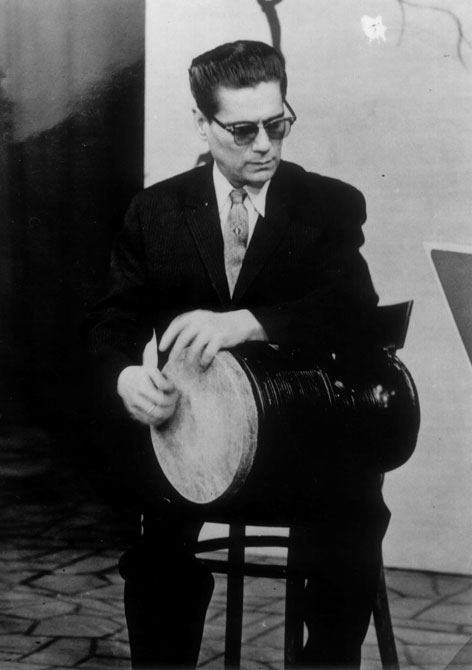
Hossein Tehrāni (1912 – February 25, 1974) (Persian: حسین تهرانی), was an Iranian musician and tonbak player. He is regarded as the father of the modern tonbak.

He was born in Tehran, Iran. At an early age he was going to Zurkhaneh -زورخانه (an Iranian gymnasium) and was impressed by the big clay vase covered on open bottom with skin called Zarb- ضربZurkhaneh. At age if 13 Hossein found a similar type of Zarb Zurkhaneh in a smaller size which was called tonbakتنبك and began practicing by himself.

Hossein Tehrani was a tonbak instructor at the Madrese Ali Mosehgee - مدرسه عالی موسیقی (Music College) and National Music college of Tehran. Hossein innovated a rhythm technique, which involved the tonbak being played in harmony with the saying of Persian phrases such as 'Baleh vo Baleh, Baleh Digeh and Yek Sado bisto Panj.


"Fire in the Chest" by QAMAR-AL-MOLUK VAZIRI

QAMAR-AL-MOLUK VAZIRI (Waziri), commonly referred to as Qamar, the stage name of Qamar-al-Moluk Vazirizāda (1905-1959). She was a popular, pioneering Persian mezzo-soprano, much revered for her mastery of the repertoire of Persian vocal music (radif-e āvāz) and her sensitive rendition of taṣnif or through-composed metered songs (taṣnif, tarāna).

Qamar’s mezzo-soprano voice had a wide expanse; it was powerful and lyrical, accurate and sensitive, faithful to the traditional values and emotive. The tone of her voice was elegaic and plaintive, the qualities she had learned in singing the moving lamentations at religious ceremonies as a young girl. She was respected among musicians for her mastery of the modal vocal repertoire of Persian music and its various modal segments, and her nuanced declamatory delivery of them. Qamar also excelled in her execution of all the ornamental refinements of āvāz, known as riza-kāri, and was particularly noted for her extraordinary ability in performing of the taḥrir, a falsetto break between higher and lower notes in the melody line of the āvāz, a signal trait of Persian traditional music.

As a vocalist, Qamar was respected for her musical as well as her pioneering spirit as a vocalist in public concerts as well as her progressive social and political tendencies and legendary compassion for the poor and the powerless and her generosity to them. She was the first Persian vocalist to perform in public without the socially and religiously sanctioned dress code for women, the first recording artist, and the first female vocalist to sing and record highly charged political songs such as Abu’l-Qāsem Āref’s Constitutional Revolution song Mārš-e jomhuri.  (From Encyclopædia Iranica)


Wednesday, 20 April 2011

The Kamkars – The Nobel Peace Prize Concert


The Kamkars

The Kamkars (Kurdish: Kamkaran کامکاران, Persian: کامکارها ), a Kurdish family of seven brothers and a sister, all from the city of Sanandaj, are one of the leading musical ensembles in Iran today. Their repertoire ranges from the vast array of traditional Kurdish and Persian music with its poignant, entrancing melodies and uplifting high energy rhythms to the classical Kurdish and Persian classical music of Iran. The repertoire of Kurdish music is richly diverse and deeply-rooted in the ancient history and culture of its proud and passionate people. It speaks of epic tales and wars, romantic love, and recounts ancient myths and stories of national and religious heroes, some of which date back to thousands of years to the time of the ancient Medes (the ancestors of the Kurds).”

The group has performed numerous concerts around the world, including their performance at the 2003 Nobel Peace Prize ceremony honoring Shirin Ebadi. (From Wikipedia)