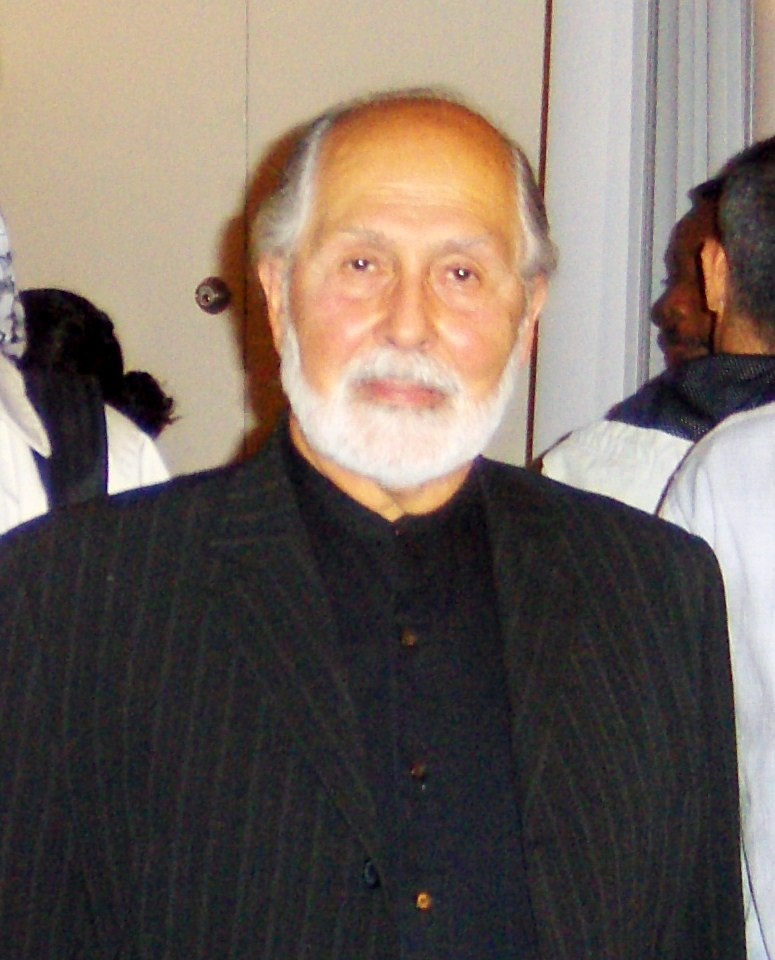
Showing posts with label Islamic Philosophy. Show all posts

Tuesday, 6 December 2011

Henry Corbin; Shiisme et Ismaélisme (French)


Henry Corbin

Henry Corbin (14 April 1903 - 7 October 1978) was a philosopher, theologian and professor of Islamic Studies at the Sorbonne in Paris, France.

Corbin was born in Paris in April 1903. As a boy he revealed the profound sensitivity to music so evident in his work. Although he was Protestant by birth, he was educated in the Catholic tradition and at the age of 19 received a certificate in Scholastic philosophy from the Catholic Institute of Paris. Three years later he took his "licence de philosophie" under the great Thomist Étienne Gilson. In 1928 he encountered the formidable Louis Massignon, director of Islamic studies at the Sorbonne, and it was he who introduced Corbin to the writings of Suhrawardi, the 12th century Persian mystic and philosopher whose work was to profoundly affect the course of Corbin’s life. The stage was then set for a personal drama that has deep significance for understanding those cultures whose roots lie in both ancient Greece and in the prophetic religions of the Near East reaching all the way back to Zoroaster. Years later Corbin said “through my meeting with Suhrawardi, my spiritual destiny for the passage through this world was sealed. Platonism, expressed in terms of the Zoroastrian angelology of ancient Persia, illuminated the path that I was seeking.”

Corbin is responsible for redirecting the study of Islamic philosophy as a whole. In his Histoire de la philosophie islamique (1964), he disproved the common view that philosophy among the Muslims came to an end after Ibn Rushd, demonstrating rather that a lively philosophical activity persisted in the eastern Muslim world – especially Iran – and continues to our own day. (From Wikipedia)


Tuesday, 6 September 2011

Abdolkarim Soroush: "Shi'ism in Need of Reform"


Dr. Abdolkarim Soroush


Abdolkarim Soroush (عبدالكريم سروش), born Hosein Haj Faraj Dabbagh (1945-; Persian: حسين حاج فرج دباغ), is an Iranian thinker, reformer, Rumi scholar and a former professor at the University of Tehran. He is arguably the most influential figure in religious intellectual movement in Iran. Professor Soroush is currently a visiting scholar at the University of Maryland in College Park, MD. He was also affiliated with other prestigious institutions, including Harvard, Princeton, Yale, Columbia, the Leiden based International Institute for the Study of Islam in the Modern World (ISIM) and the Wissenschaftskolleg in Berlin. Soroush idea's, founded on Relativism prompted both supporters and critics to compare his role in reforming Islam to that of Martin Luther in reforming Christianity. (From Wikipedia).


Sunday, 3 July 2011

Timothy Winter: The life and works of al-Ghazali

Al-Ghazâlî


Al-Ghazâlî (c.1055–1111) was one of the most prominent and influential philosophers, theologians, jurists, and mystics of Sunni Islam. He was active at a time when Sunni theology had just passed through its consolidation and entered a period of intense challenges from Shiite Ismâ’îlite theology and the Arabic tradition of Aristotelian philosophy (falsafa). Al-Ghazâlî understood the importance of falsafa and developed a complex response that rejected and condemned some of its teachings, while it also allowed him to accept and apply others. Al-Ghazâlî's critique of twenty positions of falsafa in his Incoherence of the Philosophers (Tahâfut al-falâsifa) is a significant landmark in the history of philosophy as it advances the nominalist critique of Aristotelian science developed later in 14th century Europe. On the Arabic and Muslim side al-Ghazâlî's acceptance of demonstration (apodeixis) led to a much more refined and precise discourse on epistemology and a flowering of Aristotelian logics and metaphysics. With al-Ghazâlî begins the successful introduction of Aristotelianism or rather Avicennism into Muslim theology. After a period of appropriation of the Greek sciences in the translation movement from Greek into Arabic and the writings of the falâsifa up to Avicenna (Ibn Sînâ, c.980–1037), philosophy and the Greek sciences were “naturalized” into the discourse of kalâm and Muslim theology (Sabra 1987). Al-Ghazâlî's approach to resolving apparent contradictions between reason and revelation was accepted by almost all later Muslim theologians and had, via the works of Averroes (Ibn Rushd, 1126–98) and Jewish authors a significant influence on Latin medieval thinking. (From Stanford Encyclopedia of Philosophy)


Timothy John "Tim" Winter (Shaykh Abdal Hakim Murad)


Timothy John "Tim" Winter (born 1960), also known as Shaykh Abdal Hakim Murad, is a British Muslim researcher, writer, columnist and teacher. His profile and work have attracted media coverage both in the Muslim World and the West. Conversant in both traditional Islamic scholarship and Western thought and civilization, Winter has made contributions on many Islamic topics. (From Wikipedia)  


Monday, 2 May 2011

Seyyed Hossein Nasr Talks to Dennis Wholey about Islam


Seyyed Hossein Nasr (Persian: سید حسین نصر) (born April 7, 1933 in Tehran) is an Iranian University Professor of Islamic studies at George Washington University, and a prominent Islamic philosopher. He is the author of many scholarly books and articles.

Nasr is a Muslim Persian philosopher and renowned scholar of comparative religion, a lifelong student and follower of Frithjof Schuon, and writes in the fields of Islamic esoterism, Sufism, philosophy of science, and metaphysics.

Nasr is the first Muslim to deliver the prestigious Gifford Lectures, and in year 2000, a volume was devoted to him in the Library of Living Philosophers.

Professor Nasr speaks and writes based on the doctrine and the viewpoints of the perennial philosophy on subjects such as philosophy, religion, spirituality, music, art, architecture, science, literature, civilizational dialogues, and the natural environment. He also wrote two books of poetry (namely Poems of the Way and The Pilgrimage of Life and the Wisdom of Rumi), and has been even described as a 'polymath'.

Nasr speaks Persian, English, French, German, Spanish and Arabic fluently. (From Wikipedia)

Watch the video here.


Saturday, 30 April 2011

"Al-Ghazali: The Alchemist of Happiness" by Ovidio Salazar


ḠAZĀLĪ, ABŪ ḤĀMED MOḤAMMAD, b. Moḥammad Ṭūsī (450-505/1058-1111), one of the greatest systematic Persian thinkers of medieval Islam and a prolific Sunni author on the religious sciences (Islamic law, philosophy, theology, and mysticism) in Saljuq times.