Showing posts with label Iranian Ancient History. Show all posts

Monday, 20 February 2012

Neil MacGregor: 2600 years of history in one object, the Cyrus Cylinder

Art historian and museum director Robert Neil MacGregor


A clay cylinder covered in Akkadian cuneiform script, damaged and broken, the Cyrus Cylinder is a powerful symbol of religious tolerance and multi-culturalism. In this enthralling talk Neil MacGregor, Director of the British Museum, traces 2600 years of Middle Eastern history through this single object. (From TED)


Thursday, 29 December 2011

LURISTAN BRONZE OBJECTS

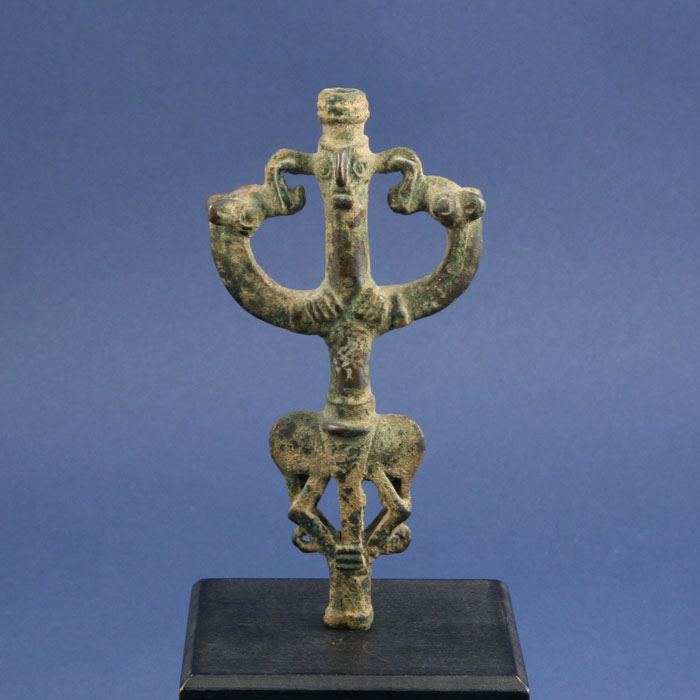
The label “Luristan bronzes” (see BRONZES OF LURISTAN) designates a series of decorated bronze objects in a specific local style dating from the Iron Age (ca. 1300/1250 to 700/650 BCE). These bronzes became known through large-scale illegal excavations starting in the late 1920s, but their cultural context and provenance remained uncertain for a long time and the label is often wrongfully used—usually for commercial reasons—for bronze objects from other regions or periods. The canonical Luristan bronzes belong to the geographical region of Luristan (present day provinces of Lorestān and Ilām), and include lost wax casts as well as sheet metal objects. Although few Luristan bronzes were found during controlled excavations, it is ascertained that the majority came from tombs, while one specific category (pins with decorated heads) have up to now only been found as ex-votos in a sanctuary. They mainly date to the Early Iron Age and are rare in Iron Age III (Overlaet, 2005, pp. 9-16).

The Luristan style is characterized by stylized human and animal forms, often combined to create fantastic creatures. Humans, birds, snakes, horses, bovid and feline species, and several species of goats are the main components. Vegetal elements are mostly used in a “tree of life” capacity, as border motifs or as filler motifs in between the principal iconography. The available evidence points to a chronological evolution from simple naturalistic themes to more complicated and fantastic creations.

There are several categories of objects that display the Luristan style. Horse gear includes horse-harness trappings and horse bits with decorative cheek pieces. Arms and equipment include spiked axe heads, adzes, daggers, swords, whetstone handles, and quiver plaques. Among the jewelry are rings, bracelets, pendants, and pins with cast or hammered sheet metal heads. An important series are the so-called “idols,” also labeled “finials” or “standards,” placed on tubular stands. Although Luristan bronzes are generally made of bronze, some are also bimetallic and consist of iron with cast-on bronze decorations (pins, bracelets, halberds, etc.). Exceptionally, there are a number of decorated iron artifacts that copy the cast bronze decorations. Since they belong to the same culture and display the same style, they should be included within the concept of Luristan bronzes (Moorey, 1991). (From Encyclopædia Iranica)


Saturday, 24 December 2011

LURISTAN BRONZE OBJECTS


The label “Luristan bronzes” (see BRONZES OF LURISTAN) designates a series of decorated bronze objects in a specific local style dating from the Iron Age (ca. 1300/1250 to 700/650 BCE). These bronzes became known through large-scale illegal excavations starting in the late 1920s, but their cultural context and provenance remained uncertain for a long time and the label is often wrongfully used—usually for commercial reasons—for bronze objects from other regions or periods. The canonical Luristan bronzes belong to the geographical region of Luristan (present day provinces of Lorestān and Ilām), and include lost wax casts as well as sheet metal objects. Although few Luristan bronzes were found during controlled excavations, it is ascertained that the majority came from tombs, while one specific category (pins with decorated heads) have up to now only been found as ex-votos in a sanctuary. They mainly date to the Early Iron Age and are rare in Iron Age III (Overlaet, 2005, pp. 9-16).

The Luristan style is characterized by stylized human and animal forms, often combined to create fantastic creatures. Humans, birds, snakes, horses, bovid and feline species, and several species of goats are the main components. Vegetal elements are mostly used in a “tree of life” capacity, as border motifs or as filler motifs in between the principal iconography. The available evidence points to a chronological evolution from simple naturalistic themes to more complicated and fantastic creations.

There are several categories of objects that display the Luristan style. Horse gear includes horse-harness trappings and horse bits with decorative cheek pieces. Arms and equipment include spiked axe heads, adzes, daggers, swords, whetstone handles, and quiver plaques. Among the jewelry are rings, bracelets, pendants, and pins with cast or hammered sheet metal heads. An important series are the so-called “idols,” also labeled “finials” or “standards,” placed on tubular stands. Although Luristan bronzes are generally made of bronze, some are also bimetallic and consist of iron with cast-on bronze decorations (pins, bracelets, halberds, etc.). Exceptionally, there are a number of decorated iron artifacts that copy the cast bronze decorations. Since they belong to the same culture and display the same style, they should be included within the concept of Luristan bronzes (Moorey, 1991). (From Encyclopædia Iranica)





Monday, 19 December 2011

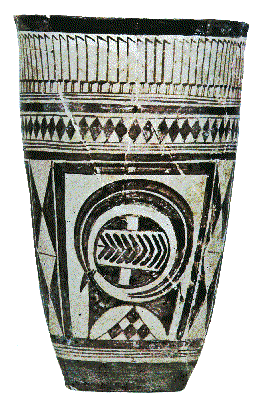
Iran Susa Painted Pottery (4500-4200 BC)

Susa


Susa (Persian: شوش Shush [ʃuʃ]; Greek: Σοῦσα [ˈsuːsa]; Syriac: ܫܘܫ Shush; Old Persian Çūšā-; Biblical Hebrew שׁוּשָׁן Shushān) was an ancient city of the Elamite, Persian and Parthian empires of Iran. It is located in the lower Zagros Mountains about 250 km (160 mi) east of the Tigris River, between the Karkheh and Dez Rivers.

The modern Iranian town of Shush is located at the site of ancient Susa. Shush is the administrative capital of the Shush County of Iran's Khuzestan province. It had a population 64,960 in 2005.

In urban history, Susa is one of the oldest-known settlements of the region and the world, possibly founded about 4200 BCE. Archeologists have dated the first traces of an inhabited Neolithic village to c 7000 BCE. Evidence of a painted-pottery civilization has been dated to c 5000 BCE. Its name in Elamite was written variously Ŝuŝan, Ŝuŝun, etc. The origin of the word Susa is from the local city deity Inshushinak. (From Wikipedia) 


Tuesday, 13 December 2011

Karen Armstrong: Ancient Iran and Its Links With Us

\
Karen Armstrong

Karen Armstrong is a British author and commentator who is the author of twelve books on comparative religion. A former Roman Catholic nun, she went from a conservative to a more liberal and mystical faith. Armstrong first rose to prominence in 1993 with her book, A History of God: The 4,000-Year Quest of Judaism, Christianity and Islam, an international best seller that is now required reading in many theology courses. Her work focuses on commonalities of the major religions, such as the importance, in many, of compassion or "The Golden Rule". (From Wikipedia) 

In her lecture here, Karen Armstrong talks about the teachings of Zoroaster and the impact of Persian Zoroastrianism on Abrahamic religions, Judeism, Christianity, and Islam. 


Monday, 12 December 2011

"People of the Flame" by David Adams

David Adams


Over the last 17 years, David Adams has developed his reputation both through his reporting and the numerous documentary films that he has written, directed and produced. He is best known for his investigative work, particularly Journeys to the Ends of the Earth, a 13 part documentary series made for the Discovery Network. His passion for anthropology, archeology, history and diverse cultures continues to take him to some of the world's most remote locations - including Afghanistan, Iran, Libya, Siberia, Central Asia, Central Africa and the Pacific Rim in search of indigenous peoples and their disappearing cultures.

In addition to his adventures in documentary filmmaking, David is a widely published photojournalist with articles appearing in over fifty countries. David has also acted as a war correspondent in Afghanistan and Georgia and has had a long-term association with The Sydney Morning Herald, as well as other popular Australian periodicals and television networks including the ABC. After a secondary education at The Kings School in Sydney, Australia, David gained a grounding in marketing, promotion and advertising. His varied and unique experience continues to take David into new realms and he is currently developing his first feature film. (From DAVID ADAMS FILMS)

In People of the Flame,  David Adams trav­els the Ira­ni­an wilder­ness in search of the Zoroas­tri­ans, an an­cient peo­ple who have tend­ed a holy flame for the last 1500 years.


Tuesday, 20 September 2011

Arg-é Bam

Arg-é Bam

Arg-é Bam


Arg-é Bam

The Arg-é Bam (ارگ بم in Persian, "Bam citadel") was the largest adobe building in the world, located in Bam, a city in the Kermān Province of southeastern Iran. It is listed by UNESCO as part of the World Heritage Site "Bam and its Cultural Landscape". This enormous citadel on the Silk Road was built before 500 BC and remained in use until 1850 AD. It is not known for certain why it was then abandoned.

The entire building was a large fortress in whose heart the citadel itself was located, but because of the impressive look of the citadel, which forms the highest point, the entire fortress is named the Bam Citadel.

Larger than nearby Arg-é Rayen, the area of Bam Citadel is approximately 180,000 square meters, and it is surrounded by gigantic walls 6-7 metres high and 1815 metres long. The citadel features two of the "stay-awake towers" for which Bam is famed - there are as many as 67 such towers scattered across the ancient city of Bam.

On December 26, 2003, the Citadel was almost completely destroyed by an earthquake, along with much of the rest of Bam and its environs.


Friday, 2 September 2011

"Cyrus Cylinder" by Spenta Productions


Cyrus Cylinder


A declaration of good kingship


This clay cylinder is inscribed in Babylonian cuneiform with an account by Cyrus, king of Persia (559-530 BC) of his conquest of Babylon in 539 BC and capture of Nabonidus, the last Babylonian king.

Cyrus claims to have achieved this with the aid of Marduk, the god of Babylon. He then describes measures of relief he brought to the inhabitants of the city, and tells how he returned a number of images of gods, which Nabonidus had collected in Babylon, to their proper temples throughout Mesopotamia and western Iran. At the same time he arranged for the restoration of these temples, and organized the return to their homelands of a number of people who had been held in Babylonia by the Babylonian kings. Although the Jews are not mentioned in this document, their return to Palestine following their deportation by Nebuchadnezzar II, was part of this policy.

This cylinder has sometimes been described as the 'first charter of human rights', but it in fact reflects a long tradition in Mesopotamia where, from as early as the third millennium BC, kings began their reigns with declarations of reforms. (From the British Museum)


Text of Cyrus Cylinder


Translation of the text on the Cyrus Cylinder by Irving Finkel

  1. [When ... Mar]duk, king of the whole of heaven and earth, the ....... who, in his ..., lays waste his .......
  2. [........................................................................]broad ? in intelligence, ...... who inspects} (?) the wor]ld quarters (regions)
  3. [..............................................................…] his [first]born (=Belshazzar), a low person was put in charge of his country,
  4. but [..................................................................................] he set [a (…) counter]feit over them. 
  5. He ma[de] a counterfeit of Esagil, [and .....….......]... for Ur and the rest of the cult-cities.
  6. Rites inappropriate to them, [impure] fo[od- offerings ….......................................................] disrespectful […] were daily gabbled, and, as an insult,
  7. he brought the daily offerings to a halt; he inter[fered with the rites and] instituted […....] within the sanctuaries. In his mind, reverential fear of Marduk, king of the gods, came to an end.   
  8. He did yet more evil to his city every day; … his [people ................…], he brought ruin on them all by a yoke without relief.  
  9. Enlil-of-the-gods became extremely angry at their complaints, and […] their territory.  The gods who lived within them left their shrines,
  10. angry that he had made (them) enter into Shuanna (Babylon).  Ex[alted Marduk, Enlil-of-the-Go]ds, relented.  He changed his mind about all the settlements whose sanctuaries were in ruins, 
  11. and the population of the land of Sumer and Akkad who had become like corpses, and took pity on them.  He inspected and checked all the countries, 
  12. seeking for the upright king of his choice.  He took the hand of Cyrus, king of the city of Anshan, and called him by his name, proclaiming him aloud for the kingship over all of everything.  
  13. He made the land of Guti and all the Median troops prostrate themselves at his feet, while he shepherded in justice and righteousness the black-headed people 
  14. whom he had put under his care.  Marduk, the great lord, who nurtures his people, saw with pleasure his fine deeds and true heart, 
  15. and ordered that he should go to Babylon  He had him take the road to Tintir (Babylon), and, like a friend and companion, he walked at his side.  
  16. His vast troops whose number, like the water in a river, could not be counted, were marching fully-armed at his side.  
  17. He had him enter without fighting or battle right into Shuanna; he saved his city Babylon from hardship.  He handed over to him Nabonidus, the king who did not fear him.  
  18. All the people of Tintir, of all Sumer and Akkad, nobles and governors, bowed down before him and kissed his feet, rejoicing over his kingship and their faces shone.  
  19. The lord through whose help all were rescued from death and who saved them all from distress and hardship, they blessed him sweetly and praised his name.
    ------------------------------------------------- 
  20. I am Cyrus, king of the universe, the great king, the powerful king, king of Babylon, king of Sumer and Akkad, king of the four quarters of the world, 
  21. son of Cambyses, the great king, king of the city of Anshan, grandson of Cyrus, the great king, ki[ng of the ci]ty of Anshan, descendant of Teispes, the great king, king of the city of Anshan, 
  22. the perpetual seed of kingship, whose reign Bel (Marduk)and Nabu love, and with whose kingship, to their joy, they concern themselves.  When I went as harbinger of peace i[nt]o Babylon 
  23. I founded my sovereign residence within the palace amid celebration and rejoicing.  Marduk, the great lord, bestowed on me as my destiny the great magnanimity of one who loves Babylon, and I every day sought him out in awe.  
  24. My vast troops were marching peaceably in Babylon, and the whole of [Sumer] and Akkad had nothing to fear.  
  25. I sought the safety of the city of Babylon and all its sanctuaries.  As for the population of Babylon […, w]ho as if without div[ine intention] had endured a yoke not decreed for them, 
  26. I soothed their weariness; I freed them from their bonds(?).    Marduk, the great lord,  rejoiced at [my good] deeds, 
  27. and he pronounced a sweet blessing over me, Cyrus, the king who fears him, and over Cambyses, the son [my] issue, [and over] my all my troops, 
  28. that we might live happily in his presence, in well-being.  At his exalted command, all kings who sit on thrones, 
  29. from every quarter, from the Upper Sea to the Lower Sea, those who inhabit [remote distric]ts (and) the kings of the land of Amurru who live in tents, all of them, 
  30. brought their weighty tribute into Shuanna, and kissed my feet. From [Shuanna] I sent back to their places to the city of Ashur and Susa, 
  31. Akkad, the land of Eshnunna, the city of Zamban, the city of Meturnu, Der, as far as the border of the land of Guti - the sanctuaries across the river Tigris - whose shrines had earlier become dilapidated, 
  32. the gods who lived therein, and made permanent sanctuaries for them.  I collected together all of their people and returned them to their settlements, 
  33. and the gods of the land of Sumer and Akkad which Nabonidus – to the fury of the lord of the gods – had brought into Shuanna, at the command of Marduk, the great lord, 
  34. I returned them unharmed to their cells, in the sanctuaries that make them happy.  May all the gods that I returned to their sanctuaries, 
  35. every day before Bel and Nabu, ask for a long life for me, and mention my good deeds, and say to Marduk, my lord, this: “Cyrus, the king who fears you, and Cambyses his son,
  36. may they be the provisioners of our shrines until distant (?) days, and the population of Babylon call blessings on my kingship. I have enabled all the lands to live in peace.  
  37. Every day I increased by [… ge]ese, two ducks and ten pigeons the [former offerings] of  geese, ducks and pigeons.
  38. I strove to strengthen the defences of the wall Imgur-Enlil, the great wall of Babylon,
  39. and [I completed] the quay of baked brick on the bank of the moat which an earlier king had bu[ilt but not com]pleted its work.  
  40. [I …… which did not surround the city] outside, which no earlier king had built, his workforce, the levee [from his land, in/int]o Shuanna.  
  41. [… .......................................................................with bitum]en and baked brick I built anew, and [completed] its [work].  
  42. […...........................................................] great [doors of cedarwood] with bronze cladding,  
  43. [and I installed] all their doors, threshold slabs and door fittings with copper parts.   [….......................] I saw within it an inscription of Ashurbanipal, a king who preceded me;
  44. […..................................................................] his … Marduk, the great lord, creator (?) of [ ... ]
  45. [….................................................] my [… I presented] as a gift.....................] your pleasure  forever. (From the British Museum)


Hormuzd Rassam

The Assyro-British archaeologist Hormuzd Rassam discovered the Cyrus Cylinder in March 1879 during a lengthy programme of excavations in Mesopotamia carried out for the British Museum.


Cyrus Kar, Founder of Spenta Productions 


Tuesday, 30 August 2011

"Persepolis Recreated" by Farzin Rezaian


Persepolis or Takht-e Jamshid


Persepolis (Pārsa, Takht-e Jamshid or Chehel Minar) was the ceremonial capital of the Achaemenid Empire (ca. 550-330 BCE). Persepolis is situated 70 km northeast of the modern city of Shiraz in the Fars Province of modern Iran. In contemporary Persian, the site is known as Takht-e Jamshid (Throne of Jamshid). The earliest remains of Persepolis date from around 515 BCE. To the ancient Persians, the city was known as Pārsa, which means "The City of Persians". Persepolis is a transliteration of the Greek Πέρσης πόλις (Persēs polis: "Persian city").  UNESCO declared the citadel of Persepolis a World Heritage Site in 1979. (


Sunday, 15 May 2011

Terry Jones' Barbarians; "The Brainy Barbarians"


Terry Jones' Barbarians is a 4-part TV documentary series first broadcast on BBC 2 in 2006. It was written and presented by Terry Jones, and it challenges the received Roman and Roman Catholic notion of the barbarian. Professor Barry Cunliffe of the University of Oxford acted as consultant for the series.

In the third episode "The Brainy Barbarians", Jones argues that the ancient Greeks and Persians were in reality far from the Roman view of them as effeminate and addicted to luxury. The Greeks valued science and mathematics, while the Persians had initially allowed multiculturalism among the different ethnic groups of its empire. (From Wikipedia)


Naghshe Rostam: Shapur I


Saturday, 23 April 2011

The Parthian Shot

The Parthian shot was a military tactic made famous by the Parthians, ancient Iranian people. The Parthian archers, mounted on light horse, would feign retreat; then, while at a full gallop, turn their bodies back to shoot at the pursuing enemy. The maneuver required superb equestrian skills, since the rider's hands were occupied by his bow. As the stirrup had not been invented at the time of the Parthians, the rider relied solely on pressure from his legs to guide his horse.
You wound, like Parthians, while you fly,
And kill with a retreating eye.
—Samuel Butler, An Heroical Epistle of Hudibras to His Lady (1678)
This tactic was used by most Eurasian nomads, including the Scythians, Huns, Turks, Magyars, and Mongols, and it eventually spread to armies away from the Eurasian steppe, such as the Sassanid clibanariis and cataphracts.

A notable battle in which this tactic was employed (by the Parthians) was the Battle of Carrhae. In this battle the Parthian shot was a principal factor in the Parthian victory over the Roman general Crassus.


Friday, 22 April 2011

Shapur I from "Iran the Forgotten Glory" by Makan Karandish

Shapur I


Shapur was the son of Ardashir I (r. 226–240 [died 242]), the founder of the Sassanid dynasty and whom Shapur succeeded. His mother was Lady Myrōd, who—according to legend—was an Arsacid princess. The Talmud cites a nickname for her, "Ifra Hurmiz", after her bewitching beauty.

One of the great achievements of Shapur's reign was the defeat of the Roman Emperor Valerian. This is presented in a mural at Naqsh-e Rustam, where Shapur is represented on horseback wearing royal armour and crown. Before him kneels Philip the Arab, in Roman dress, asking for grace. In his right hand the king grasps the uplifted arms of what may be Valerian; one of his hands is hidden in his sleeve as the sign of submission. The same scene is repeated in other rock-face inscriptions. Shapur is said to have publicly shamed Valerian by using the Roman Emperor as a footstool when mounting his horse. Other sources contradict and note that in other stone carvings, Valerian is respected and never on his knees. This is supported by reports that Valerian and some of his army lived in relatively good conditions in the city of Bishapur and that Shapur enrolled the assistance of Roman engineers in his engineering and development plans.  (From Wikipedia)


Thursday, 21 April 2011

Jiroft BBC Channel 4

The "Scorpion-man" board game of 16 playing spaces excavated at Jiroft, Iran.

A "Jiroft culture" has been postulated as an early Bronze Age (late 3rd millennium BC) archaeological culture, located in what is now Iran's Sistan and Kermān Provinces. The hypothesis is based on a collection of artifacts that were confiscated in Iran and accepted by many to have derived from the Jiroft area in south central Iran, reported by online Iranian news services, beginning in 2001.

The proposed type site is Konar Sandal, near Jiroft in the Halil River area. Other significant sites associated with the culture include; Shahr-e Sukhteh (Burnt City), Tepe Bampur, Espiedej, Shahdad, Iblis, and Tepe Yahya.

The proposition of grouping these sites as an "independent Bronze Age civilization with its own architecture and language", intermediate between Elam to the west and the Indus Valley Civilization to the east, is due to Yousef Majidzadeh, head of the archaeological excavation team in Jiroft. Yousef Majidzadeh speculates they may be the remains of the lost Aratta Kingdom. Yousef Majidzadeh's conclusions have met with skepticism from some reviewers. Other conjectures (e.g. Daniel T. Potts, Piotr Steinkeller) have connected the Konar Sandal with the obscure city-state of Marhashi, that apparently lay to the east of Elam proper. (from Wikipedia)