Showing posts with label Iran Travel. Show all posts

Tuesday, 24 January 2012

Découverte du Monde: Ispahan (French)


Isfahan (Persian: اصفهان Esfahān), historically also rendered in English as Ispahan, Sepahan or Hispahan, is the capital of Isfahan Province in Iran, located about 340 km south of Tehran. It has a population of 1,583,609 and is Iran's third largest city after Tehran and Mashhad. The Isfahan metropolitan area had a population of 3,430,353 in the 2006 Census, the second most populous metropolitan area in Iran after Tehran.

The cities of Najafabad, Se-deh (Homayounshahr, renamed Khomeinishahr since 1981), Khan Isfahan, Shahin-shahr, Zarrinshahr, Mobarakeh, Falavarjan and Fouladshahr all constitute the metropolitan city of Isfahan.

Isfahan is located on the main north-south and east-west routes crossing Iran, and was once one of the largest cities in the world. It flourished from 1050 to 1722, particularly in the 16th century under the Safavid dynasty, when it became the capital of Persia for the second time in its history. Even today, the city retains much of its past glory. It is famous for its Islamic architecture, with many beautiful boulevards, covered bridges, palaces, mosques, and minarets. This led to the Persian proverb "'Esfahān nesf-e jahān ast" (Isfahan is half of the world).

The Naghsh-e Jahan Square in Isfahan is one of the largest city squares in the world and an outstanding example of Iranian and Islamic architecture. It has been designated by UNESCO as a World Heritage Site. The city also has a wide variety of historic monuments. (From Wikipedia)


Tuesday, 20 September 2011

Arg-é Bam

Arg-é Bam

Arg-é Bam


Arg-é Bam

The Arg-é Bam (ارگ بم in Persian, "Bam citadel") was the largest adobe building in the world, located in Bam, a city in the Kermān Province of southeastern Iran. It is listed by UNESCO as part of the World Heritage Site "Bam and its Cultural Landscape". This enormous citadel on the Silk Road was built before 500 BC and remained in use until 1850 AD. It is not known for certain why it was then abandoned.

The entire building was a large fortress in whose heart the citadel itself was located, but because of the impressive look of the citadel, which forms the highest point, the entire fortress is named the Bam Citadel.

Larger than nearby Arg-é Rayen, the area of Bam Citadel is approximately 180,000 square meters, and it is surrounded by gigantic walls 6-7 metres high and 1815 metres long. The citadel features two of the "stay-awake towers" for which Bam is famed - there are as many as 67 such towers scattered across the ancient city of Bam.

On December 26, 2003, the Citadel was almost completely destroyed by an earthquake, along with much of the rest of Bam and its environs.


Friday, 16 September 2011

"The Flamingos Return to Rezaieh" by Mutual of Omaha's Wild Kingdom

The Flamingos Return to Rezaieh by Mutual of Omaha's Wild Kingdom


Wild Kingdom, sometimes known as Mutual of Omaha's Wild Kingdom, is an American television show that features wildlife and nature. It was originally produced from 1963 until 1988, and was revived in 2002. The show's second incarnation currently airs on Animal Planet in the U.S. This video is an episode of the show about Lake Urmia's Flamingos in Rezaieh (Oromieh or Urmia).

Lake Urmia (Azerbaijani: Urmu Gölü , Urmia Gölü ; Persian: دریاچه ارومیه Daryâcheh-ye Orumiyeh (or Oroumieh), ancient name: Lake Matiene) is a salt lake in northwestern Iran, near Iran's border with Turkey. The lake is between the Iranian provinces of East Azerbaijan and West Azerbaijan, west of the southern portion of the similarly shaped Caspian Sea. It is the largest lake in the Middle East, and the third largest salt water lake on earth, with a surface area of approximately 5,200 km² (2,000 mile²), 140 km (87 miles) length, 55 km (34 miles) width, and 16 m (52 ft) depth. (From Wikipedia)


Thursday, 18 August 2011

"Mashhad" a View by a Corrector of Persian Carpets

Imam Reza Shrine

Mashhad (Persian: مشهد Mashhad, Arabic: مشهد Mašhad‎, English: The Place of Martyrdom), is the second largest city in Iran and one of the holiest cities in the Shia Muslim world. It is also the only major Iranian city with an Arabic name. It is located 850 kilometres (530 mi) east of Tehran, at the center of the Razavi Khorasan Province close to the borders of Afghanistan and Turkmenistan. Its population was 2,427,316 at the 2006 population census.

Now Mashhad is notably known as the resting place of the Imam Reza. A shrine was later built there to commemorate the Imam, which in turn gave rise to increasing demographic development.

Mashhad is also known as the city of Ferdowsi, the Iranian poet of Shahnameh, which is considered to be the national epic of Iran. (From Wikipedia)


Ferdowsi Tomb Mashhad


Thursday, 7 July 2011

Forgotten Iran (1971) – a film by Claude Lelouch


French Director Claude Lelouch

Claude Pinoteau and Claude Lelouch shot their documentary just after the Persepolis Celebrations in 1971. They decided to address the urban transformations and cultural emancipation that the country was subject to by the early seventies. (From Wikipedia)


Monday, 4 July 2011

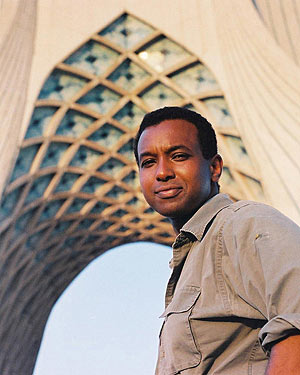
Welcome to Tehran - a journey by Rageh Omaar

Rageh Omaar

Welcome to Tehran (1 x 90 min) is an observational documentary that sets out to look at the region and its people not through politicians, officials and analysts but through the eyes of ordinary Iranians.

Omaar has visited Tehran - the region's capital - once before as a news reporter, filming the incendiary demonstrations and recording the uncompromising statements from officials since the aftermath of the Islamic Revolution of 1979.

But his experiences of being in the city never left him.

He says: "There is an energy and vitality to the place that is completely different from the usual images we in the West have of it. And that's why I wanted to return."

In making the film, Omaar tried to see Iran from the inside by visiting people's homes and travelling through a rich variety of neighbourhoods and districts of the city.

Omaar and Producer/Director Paul Sapin struggled for a year to get the right kind of access which gave them the freedom to fully explore these rarely filmed areas.

The film is told as a journey through Tehran but also as a very personal essay by Omaar as he digs deeper into this complex and fascinating society.

Omaar's journey takes him under the skin of the city and he meets with local people who share with him their personal stories and feelings about the current state of affairs in Iran.

There are stories of taxi drivers; wrestlers; business women; people working with drug addicts and the country's leading pop star and his manager - the Simon Cowell of Iran - who drove Omaar around Tehran in his Mercedes-Benz.

Paul Sapin says: "Iran has become a closed society to the West and it is a real challenge to produce a genuine documentary in this region due to problems with access for Western journalists, but wherever we went, we were met with warmth and hospitality.

"Iran is not the austere, humourless place we're led to believe and that was certainly Rageh's experience." (From BBC)


Saturday, 18 June 2011

Valiasr (Pahlavi) Street, Tehran

Valiasr Street (Persian: ولی عصر ) is a tree-lined street in Tehran, Iran, dividing the metropolis into western and eastern parts. It is considered one of Tehran's main thoroughfares and commercial centres. It is also the longest street in the Middle East, and was reported as one of the longest in the world by former BBC (now Al Jazeera) journalist Rageh Omaar during the television documentary Welcome to Tehran.

The street was built by Reza Shah Pahlavi's order and called the Pahlavi Street. After the 1979 Islamic Revolution the street's name was changed initially to Mossadeq Street (in reference to former nationalist prime minister Mohammad Mossadeq) and later to Valiasr (a reference to the 12th Shi'ite Imam). Valiasr Street is the hub of different activities in Tehran and innumerable shops and restaurants as well a large number of parks (like Mellat Park), highways, cultural centers are situated along this long avenue.
Valiasr runs from the Tehran's railway station (1117 meters elevation above see level) in the south of the city
to the Tajrish square (1612 meters elevation above see level) in the north.

Valiasr runs for 12 miles (19.3 kilometers), north to south, and is filled with traffic at all hours, even until the early hours of the morning. The shops stay open late and the kiosks sell fresh fruit juice, coffee and newspapers. (From Wikipedia)


Valiasr (Pahlavi) Street, Tehran
 

Monday, 23 May 2011

Rick Steves' IRAN


Richard "Rick" Steves (born May 10, 1955, Edmonds, Washington) is an American author, historian, and television personality focusing on European travel. He is the host of the public television series Rick Steves' Europe, has a public radio travel show, Travel with Rick Steves, and has authored various location-specific travel guides. (From Wikipedia)