Thursday, 29 December 2011

LURISTAN BRONZE OBJECTS

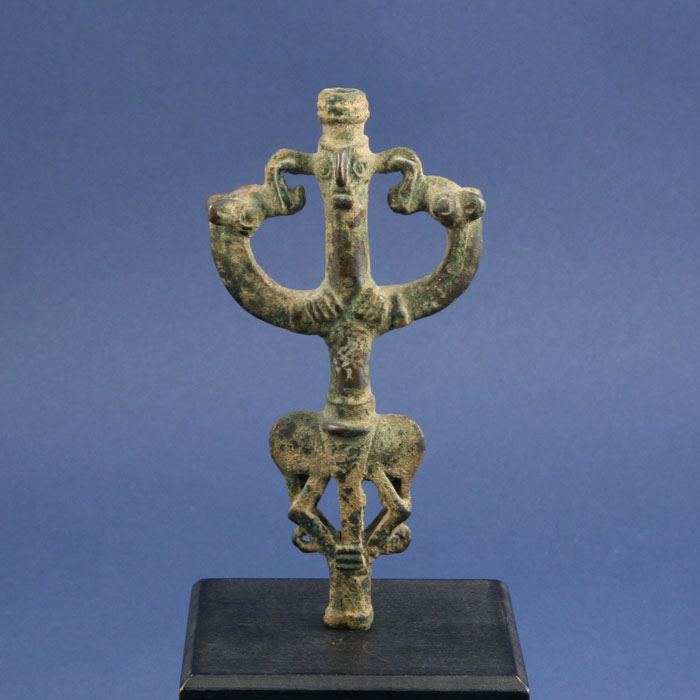
The label “Luristan bronzes” (see BRONZES OF LURISTAN) designates a series of decorated bronze objects in a specific local style dating from the Iron Age (ca. 1300/1250 to 700/650 BCE). These bronzes became known through large-scale illegal excavations starting in the late 1920s, but their cultural context and provenance remained uncertain for a long time and the label is often wrongfully used—usually for commercial reasons—for bronze objects from other regions or periods. The canonical Luristan bronzes belong to the geographical region of Luristan (present day provinces of Lorestān and Ilām), and include lost wax casts as well as sheet metal objects. Although few Luristan bronzes were found during controlled excavations, it is ascertained that the majority came from tombs, while one specific category (pins with decorated heads) have up to now only been found as ex-votos in a sanctuary. They mainly date to the Early Iron Age and are rare in Iron Age III (Overlaet, 2005, pp. 9-16).

The Luristan style is characterized by stylized human and animal forms, often combined to create fantastic creatures. Humans, birds, snakes, horses, bovid and feline species, and several species of goats are the main components. Vegetal elements are mostly used in a “tree of life” capacity, as border motifs or as filler motifs in between the principal iconography. The available evidence points to a chronological evolution from simple naturalistic themes to more complicated and fantastic creations.

There are several categories of objects that display the Luristan style. Horse gear includes horse-harness trappings and horse bits with decorative cheek pieces. Arms and equipment include spiked axe heads, adzes, daggers, swords, whetstone handles, and quiver plaques. Among the jewelry are rings, bracelets, pendants, and pins with cast or hammered sheet metal heads. An important series are the so-called “idols,” also labeled “finials” or “standards,” placed on tubular stands. Although Luristan bronzes are generally made of bronze, some are also bimetallic and consist of iron with cast-on bronze decorations (pins, bracelets, halberds, etc.). Exceptionally, there are a number of decorated iron artifacts that copy the cast bronze decorations. Since they belong to the same culture and display the same style, they should be included within the concept of Luristan bronzes (Moorey, 1991). (From Encyclopædia Iranica)



Saturday, 24 December 2011

LURISTAN BRONZE OBJECTS


The label “Luristan bronzes” (see BRONZES OF LURISTAN) designates a series of decorated bronze objects in a specific local style dating from the Iron Age (ca. 1300/1250 to 700/650 BCE). These bronzes became known through large-scale illegal excavations starting in the late 1920s, but their cultural context and provenance remained uncertain for a long time and the label is often wrongfully used—usually for commercial reasons—for bronze objects from other regions or periods. The canonical Luristan bronzes belong to the geographical region of Luristan (present day provinces of Lorestān and Ilām), and include lost wax casts as well as sheet metal objects. Although few Luristan bronzes were found during controlled excavations, it is ascertained that the majority came from tombs, while one specific category (pins with decorated heads) have up to now only been found as ex-votos in a sanctuary. They mainly date to the Early Iron Age and are rare in Iron Age III (Overlaet, 2005, pp. 9-16).

The Luristan style is characterized by stylized human and animal forms, often combined to create fantastic creatures. Humans, birds, snakes, horses, bovid and feline species, and several species of goats are the main components. Vegetal elements are mostly used in a “tree of life” capacity, as border motifs or as filler motifs in between the principal iconography. The available evidence points to a chronological evolution from simple naturalistic themes to more complicated and fantastic creations.

There are several categories of objects that display the Luristan style. Horse gear includes horse-harness trappings and horse bits with decorative cheek pieces. Arms and equipment include spiked axe heads, adzes, daggers, swords, whetstone handles, and quiver plaques. Among the jewelry are rings, bracelets, pendants, and pins with cast or hammered sheet metal heads. An important series are the so-called “idols,” also labeled “finials” or “standards,” placed on tubular stands. Although Luristan bronzes are generally made of bronze, some are also bimetallic and consist of iron with cast-on bronze decorations (pins, bracelets, halberds, etc.). Exceptionally, there are a number of decorated iron artifacts that copy the cast bronze decorations. Since they belong to the same culture and display the same style, they should be included within the concept of Luristan bronzes (Moorey, 1991). (From Encyclopædia Iranica)







Monday, 19 December 2011

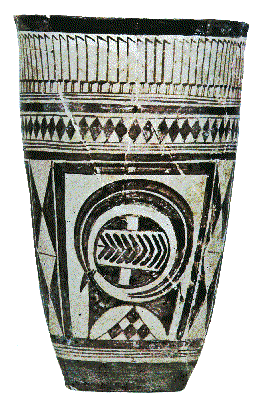
Iran Susa Painted Pottery (4500-4200 BC)

Susa


Susa (Persian: شوش Shush [ʃuʃ]; Greek: Σοῦσα [ˈsuːsa]; Syriac: ܫܘܫ Shush; Old Persian Çūšā-; Biblical Hebrew שׁוּשָׁן Shushān) was an ancient city of the Elamite, Persian and Parthian empires of Iran. It is located in the lower Zagros Mountains about 250 km (160 mi) east of the Tigris River, between the Karkheh and Dez Rivers.

The modern Iranian town of Shush is located at the site of ancient Susa. Shush is the administrative capital of the Shush County of Iran's Khuzestan province. It had a population 64,960 in 2005.

In urban history, Susa is one of the oldest-known settlements of the region and the world, possibly founded about 4200 BCE. Archeologists have dated the first traces of an inhabited Neolithic village to c 7000 BCE. Evidence of a painted-pottery civilization has been dated to c 5000 BCE. Its name in Elamite was written variously Ŝuŝan, Ŝuŝun, etc. The origin of the word Susa is from the local city deity Inshushinak. (From Wikipedia) 


Thursday, 15 December 2011

Asghar Farhadi: "A Separation" (2011)


A Separation (Persian: جدایی نادر از سیمین, translit. Jodái-e Náder az Simin) is a 2011 Iranian drama film written and directed by Asghar Farhadi, starring Leila Hatami, Peyman Moaadi, Shahab Hosseini, Sareh Bayat and Sarina Farhadi. It focuses on an Iranian middle-class couple who separate, and the intrigues which follow when the husband hires a lower-class caretaker for his elderly father. The film received the Golden Bear for Best Film and the Silver Bears for Best Actress and Best Actor at the 61st Berlin International Film Festival, becoming the first Iranian film to win the Golden Bear.The film is the official Iranian candidate for the Best Foreign Language Film at the Academy Awards. (From Wikipedia)


Asghar Farhadi
  

Asghar Farhadi is a graduate of Theatre, with a BA in Dramatic Arts and MA in Stage Direction from Tehran University and Tarbiat Modarres University. Farhadi made short 8mm and 16mm films in Isfahan branch of Iranian Young Cinema Society before moving on to writing plays and screenplays for IRIB. He also directed such TV series as the popular A Tale of a City and co-wrote the screenplay of Ebrahim Hatamikia’s Low Heights. Dancing in the Dust was his feature film debut, which he followed with the critically acclaimed A Beautiful City.

His third film, Fireworks Wednesday won the Gold Hugo at the 2006 Chicago International Film Festival. His fourth film, About Elly won the Silver Bear for Best Director at 59th International Berlin Film Festival as well as Best Picture at Tribeca Film Festival. It is about a group of Iranians who take a trip to the Caspian Sea that turns tragic. Famous film theorist and film critic David Bordwell has called About Elly a masterpiece.

His latest film Nader and Simin, A Separation premiered on 9 February 2011 at the 29th Fajr International Film Festival in Tehran and received rave reviews from Iran Society of Film Critics. It won Farhadi four awards including Best Director (for the third time after Fireworks Wednesday and About Elly). On 15 February it also played in competition at the 61st Berlin International Film Festival which finally earned him Golden Bear for best film becoming the first Iranian film to win the Golden Bear. In June 2011, A Separation won the Sydney Film Prize in competition with Cannes Festival's winner The Tree of Life directed by Terrence Malick . (From Wikipedia)

"A Separation" could hardly be more concrete, or contemporary, or dramatic.
Joe Morgenstern
Wall Street Journa

Farhadi demonstrates a Hitchcockian flair for suspense, while his cast deliver faultless performances.
Lewis Porteous
Skinny
 
One of the year's best foreign films, A Separation goes beyond its particular Iranian tale of a marital dissolution, contesting along the way gender, cultural, and religious values and taboos.  
Emanuel Levy
EmanuelLevy.Com

A light yet powerful Islamic family drama that refuses to cave in to stereotypes.

Ron Wilkinson
Monsters and Critics

A solid Iranian Oscar-entry that puts women in the forefront in a battle of wills that happily posits more questions than answers.
Harvey S. Karten
Compuserve

It resonates deeply thanks to its universality, which it miraculously achieves without ever once selling out the social mores of its location. Profoundly affecting, wonderfully performed and endlessly surprising.

Simon Miraudo
Quickflix 

A masterpiece of intimate, dramatic filmmaking.
Tom Clift
Cut Print Review

The iniquities of contemporary Iran are essayed in this absorbing, award-winning marital drama about the ways in which tiny events can have cataclysmic consequences.
Alistair Harkness
Scotsman

A stunning piece of work, beautifully telling a raw human story with expert writing, direction, photography, editing and acting. 

Rich Cline
Shadows on the Wall
 
A Separation twists and turns, layering on crucial details and moral quandaries in each scene, never for a moment allowing us the luxury of identifying too easily with any single character.
Sukhdev Sandhu
Daily Telegraph
 
You won't see a more absorbing film all year.
David Edwards
Daily Mirror [UK]  (From Rotten Tomatoes)