

ASK US ABOUT ANYTHING PERSIAN
Saturday, 27 April 2013

Wednesday, 24 April 2013

Monday, 22 April 2013
Omar Khayyam - The Poet of Uncertainty (BBC)

Born Ghiyath al-Din Abul Fatah Umar Ibn Ibrahim al-Khayyam in 1044 in Nishapur, a Persian city, Omar Khayyam was a well-known mathematician, astronomer, philosopher, and poet. He spent most of his life in Persian intellectual centres such as Samarkand and Bukhara, and enjoyed the favour of the Seljuk sultans who ruled the region.
Khayyam's best-known scientific contributions were in algebra and astronomy. His classification of algebraic equations was fundamental to the advancement of algebra as a science, for example, just as his work on the theory of parallel lines was important in geometry. In astronomy, Khayyam's greatest legacy is a remarkably accurate solar calendar, which he developed when the Seljuk sultan, Malik-Shah Jalal al-Din, required a new schedule for revenue collection. Khayyam's calendar, called Al-Tarikh-al-Jalali after the sultan, was even more accurate than the Gregorian calendar presently used in most of the world: the Jalali calendar had an error of one day in 3770 years, while the Gregorian had an error of one day in 3330 years. Khayyam measured the length of one year as 365.24219858156 days, which is remarkably accurate. It has since been discovered that the number changes in the 6th decimal place over a person's lifetime. For comparison of Khayyam's accuracy, the length of one year at the end of the 19th century was 365.242196 days, and today it is 365.242190. Although the calendar project was cancelled upon Malik-Shah's death in 1092, the Jalali calendar has survived and is still used in parts of Iran and Afghanistan today.
Khayyam is also a well-known poet. This is the profession by which he is best-known in the West, often at the expense of his scientific achievements. His fame as a poet in the West has only existed since 1839, however, when Edward Fitzgerald published an English translation of Khayyam's Rubaiyat ("Quatrains"). It has since become a classic of world literature, and is largely responsible for influencing European ideas about Persian poetry and literature. Because he was known as a scientist in his own time, and his poetry did not surface until 200 years after his death, some doubt whether Khayyam indeed wrote the Rubaiyat. After careful analysis, however, most scholars now agree that he is the author, revealing a philosophical side to Khayyam that few of his contemporaries knew.
Khayyam's legacy remains largely in science, however, with his work in geometry so far ahead of its time that it was not used again until Descartes built upon Khayyam's theories in 17th century France.
Friday, 19 April 2013
The Persian Traditional Music Golha Project: Jane Lewisohn
 |
| Jane Lewisohn |
Jane Lewisohn lived in Iran during the 1970s for six years and is a graduate of Pahalavi University, Shiraz, Iran. She has been involved in the research and promotion of various aspects of Persian Studies for the last three decades. Since 2005 she has been directing the Golha Project under the auspices of the British Library, London, and the Music Department of SOAS, University of London. She has archived and digitalised the whole archive of the Golha radio programmes broadcast on Iranian Radio from 1956 through 1979. She is now working in collaboration with the IHF to make this Golha Archive and all the related research concerning the Golha Archive available over the internet at http://www.golha.co.uk. (From SOAS University of London)
The Golha (‘Flowers of Persian Song and Music’) radio programmes were broadcast on Iranian National Radio for 23 years from 1956 through 1979. They comprised approximately 850 hours of programmes made up of literary commentary with the declamation of poetry, which is also sung with musical accompaniment, interspersed with solo musical pieces. The programmes themselves were the brainchild of Davoud Pirnia, a one-time Assistant Prime Minister, who in addition to being a well-known politician and judge, was an enthusiastic patriot and scholar who harboured a deep love for Persian culture and its rich literary and musical traditions. When he retired from political life in 1956, for the next eleven years he devoted himself tirelessly to producing of the Golha programmes. (By Jane Lewisohn)
Wednesday, 17 April 2013
Azadeh Akhlaghi; By An Eye-Witness
 |
| Azadeh Akhlaghi |
Born in 1978, in Shiraz Azadeh Akhlaghi studied computer science at RMIT University. She is a conceptual artist who began her career in 2001. Akhlaghi’s main concerns are photography, video-arts and short movies. Akhlaghi’s practice acknowledges conceptual approaches to contemporary art through photography. She has made a number of short films which have been screened in numerous film festivals such as the Berkeley Art Museum, Pusan and Oslo. From 2001 to 2010 Akhlaghi has participated in numerous art exhibitions ranging from such countries as Iran, Australia, England to Turkey. Akhlaghi has also won a number of international prizes including the third prize of the UN Habitat Photography Competition and the first prize of the Women and Urban Life Competition of Iran. (From Galley MAMAK)
In her project By An Eye-Witness, Akhlaghi photographically reconstructs the death stories of a number of significant Iranian personalities. These figures include influential politicians, journalists, writers, and sports celebrities. The following passage has been written by Azadeh Akhlaghi about By An Eye-Witness.
"Is it possible for a moment in present time to become so tumultuous and critical to break the linearity of time, bring the past to the present and thrust the dwellers of the present to the past? Is it possible that we come upon a radical opening in the course of history, through which the spirit of those who fought and died tragically for a common cause, walk alongside us shoulder-to-shoulder in the streets of our contemporary cities? Is it viable that a human being, doomed to the present time, takes the spirits of his precursors out of the massive ruins of history, call them on to the present, and relishes their precious support?
How about the opposite way? Is this extraordinary moment a new possibility to move on for us? Is it possible that we, in the heat of the moment, manage to detach from the triviality of our everyday life and travel back through history? A journey backward, not through memory or mind or analysis or reading or writing, but through our very flesh and blood, which seems profoundly attached to the moment?
The point of departure of this project derives from the shock – a collective shock – of the present, rather than a historical preoccupation and is a meditation on those possibilities. Perhaps what I bring to the fore is nothing but utopic daydreaming, one of those candid optimistic moments that come around during abrupt social cracks and collective hopes. This is perhaps imagining simultaneity of us and the dead we admire in an essentially different time, the time that is yet to come."
CLICK PICTURES TO ENLARGE
 |
| Jahangirkhan Sur-e Esrafil, Nasrollah Malek-Al-Motekallemin - 24 June 1908 - Bagh-e Shah, Tehran |
 |
| Samad Behrangi - 03 September 1968 – Aras River, Iran |
 |
| Marzieh Ahmadi Oskuie - 26 April 1974 - Tehran |
 |
| Bijan Jazani - 18 April 1975 – Evin Hills, Tehran |
 |
| Hamid Ashraf - 29 June 1976 – South Mehrabad House, Tehran |
 |
| Ali Shariati - 18 June 1977 – Southampton, UK |
 |
| Mahmoud Taleghani -10 September 1979 - Tehran |
 |
| Mehdi Bakeri - 14 February 1985 – Majnoon Island,Iraq |
 |
| Sohrab Shahid Saales – 1July 1998 - Chicago |
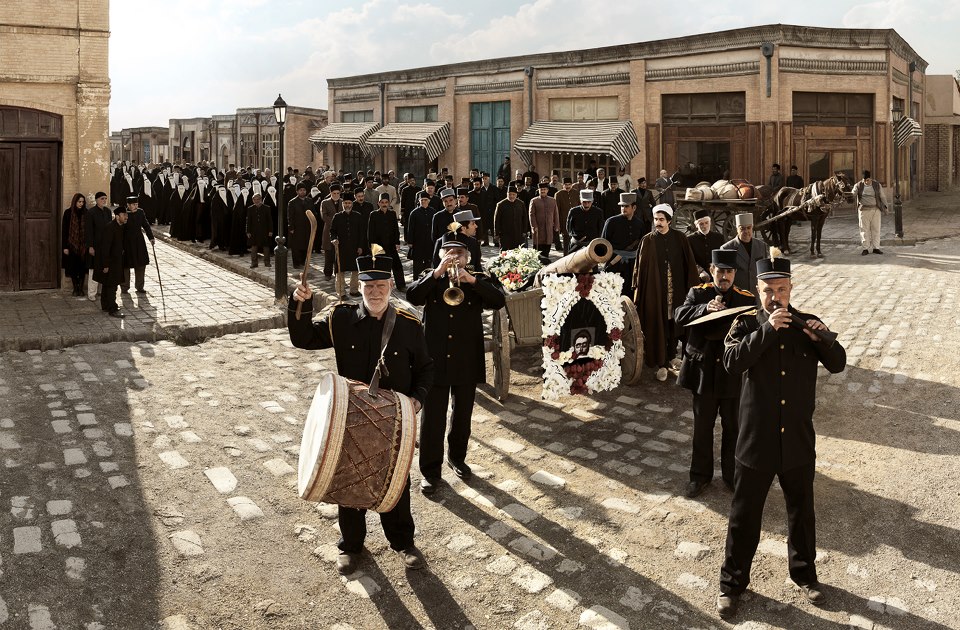 |
| Colonel Mohammad Taghi Khan Pesyan - 7 October 1921 - Mashhad |
 |
| Mirzadeh Eshghi - 3 July 1924 - Tehran |
 |
| Mohammad Farokhi Yazdi - 18 October 1939 - Qasr Prison, Tehran |
 |
| Taghi Arani - 4 February 1940 – Tehran |
 |
| Azar Shariat Razavi, Mostafa Bozorgnia, Ahmad Ghandchi - 7 December 1953 - Faculty of Engineering, Tehran University, Tehran |
 |
| Forough Farokhzad - 13 February 1967 - Tehran |
 |
| Mohammad Mosadegh - 05 March 1967 – Ahmad-Abad, Iran |
 |
| Gholamreza Takhti - 7 January 1968 - Atlantic Hotel, Tehran |
Subscribe to:
Posts (Atom)